
As the demand for home energy storage and off-grid systems grows, the 51.2V (often referred to as 48V nominal) battery has become the industry standard. A typical module is rated at 51.2V 100Ah, delivering 5.12 kWh of usable energy.
However, if you look inside different 51.2V batteries on the market, the engineering approaches vary wildly. At our factory, we believe the most reliable ESS design uses a 16S1P (16 Series, 1 Parallel) configuration paired with a heavy-duty SPCC steel casing.
Here is the engineering truth behind why this architecture matters for long-term reliability.
Many budget-friendly batteries achieve their capacity by mixing small cells in parallel. For a 51.2V 100Ah pack, some manufacturers might use a 16S5P (80 smaller 20Ah cells) configuration.
Our 51.2V 100Ah pack takes a completely different route: it uses exactly 16 large prismatic cells (the IFP48173115 3.2V 100Ah model) in a pure 16S1P configuration.
The Math & The Physics:
16S (Series): 16 cells connected in series deliver exactly 51.2V (16 × 3.2V).
1P (Parallel): There is only 1 parallel string, providing exactly 100Ah.
Why it matters: Parallel connections create "circulating currents." Even slight differences in internal resistance between parallel cells cause them to fight each other during high-current charging and discharging. With a pure 16S1P configuration, there is absolutely zero parallel circulating current. Every single cell is doing the exact same amount of work.
The BMS can track every cell with pinpoint accuracy, and the AC internal resistance is strictly controlled between 10mΩ to 30mΩ. This translates to a significantly longer overall system lifespan.
When you step up to a 51.2V 100Ah unit weighing 48.4 kg ± 0.5 kg, the structural requirements change dramatically.
This pack uses an SPCC (Cold-Rolled Carbon Steel) housing with a black powder coating.
Why SPCC Steel? SPCC is widely used in industrial applications for its high tensile strength and structural rigidity. Unlike plastic or thin aluminum, it does not warp or dent under heavy internal weight. If you are stacking multiple batteries in a server rack or installing them in a vibrating RV environment, the steel chassis provides ultimate physical protection.
Powder Coating: Since carbon steel is prone to rust, we apply an industrial-grade black powder coating. This coating is baked onto the metal, providing excellent corrosion resistance and scratch protection, ensuring the battery survives in humid climates or dusty garages.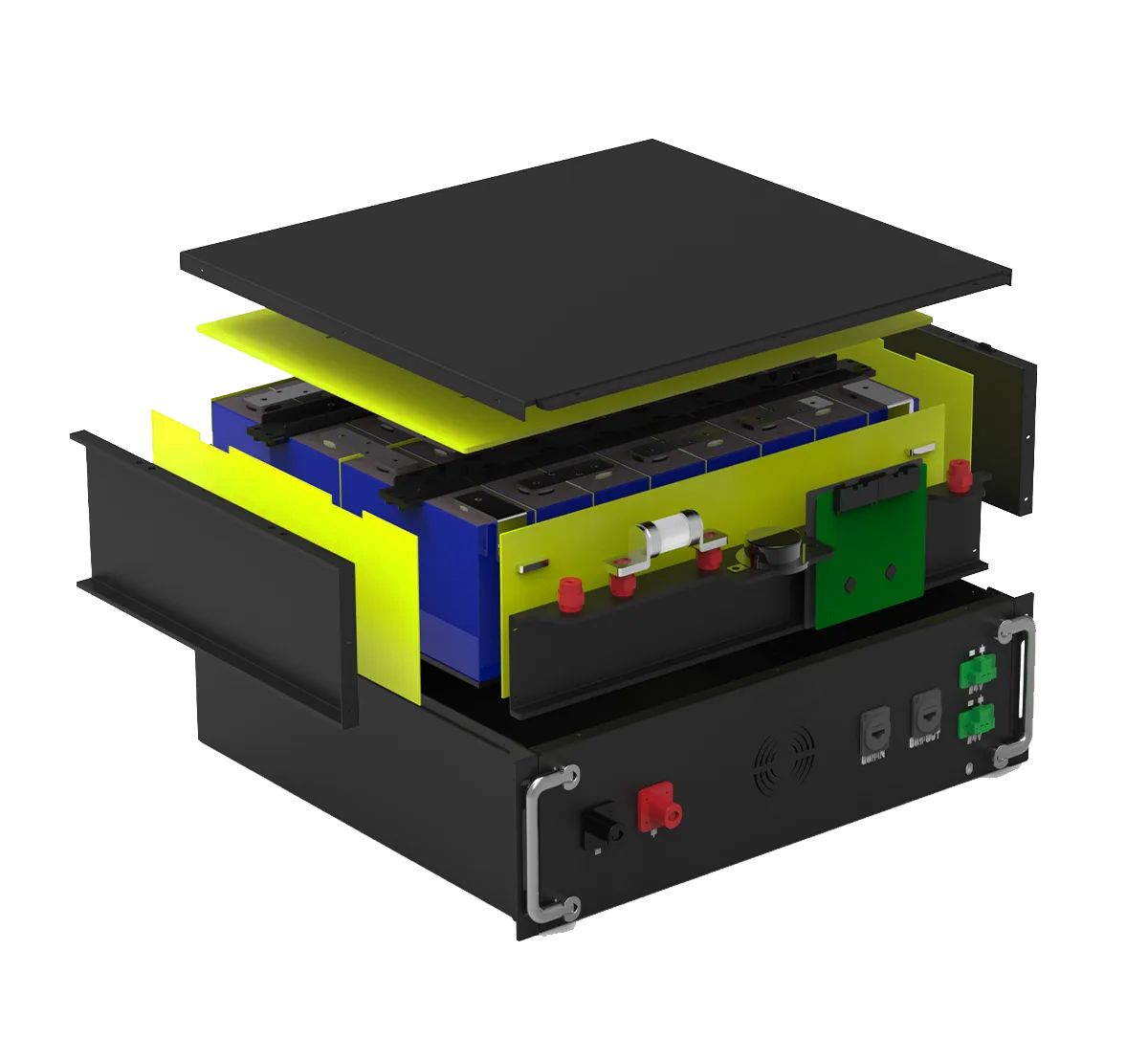
A high-quality ESS battery is not just for a lab; it needs to survive in the real world.
IP65 Rating: This pack is rated IP65, meaning it is fully protected against dust and low-pressure water jets.
Front Panel Design: Looking at the front interface, you will find two heavy-duty M29 terminals designed for thick inverter cables, alongside dual green RS485 communication ports. This standard protocol allows the battery to seamlessly communicate with mainstream inverters (like Victron, Deye, or Growatt).
Integrated Display & Breaker: The panel includes an Integrated Display Unit for on-site SOC checking, and a red circuit breaker (maintenance switch) for physical isolation and safe maintenance.
(Figure 1: Exploded view of our 51.2V 100Ah pack, showcasing the pure 16S1P cell arrangement inside the SPCC steel casing.)
Knowing the limits of your battery is just as important as the capacity itself.
Charging: The standard CC/CV charge profile is 57.6V to 58.4V. At a standard 0.2C rate (20A), a full charge takes roughly 7 hours—perfect for overnight charging on solar systems. The maximum charge current is 60A.
Discharging: The maximum continuous discharge current is 46A, with a recommended continuous of 20A. This means it is optimized for steady, long-duration energy release (like powering your house through the night), rather than short bursts of massive power.
Low Voltage Cut-off: The system recommends a cut-off at 44.8V (2.8V per cell). This strict low-voltage protection prevents the LFP cells from over-discharging, ensuring the 2000-cycle lifespan (to >80% capacity) holds true.
A 51.2V 100Ah battery is the building block of modern energy storage. By utilizing a 16S1P zero-parallel architecture, a high-strength SPCC steel casing with powder coating, and RS485 smart communication, this system is built to last.
When selecting a 51.2V ESS battery, ask:
What is the internal cell configuration? (Is it 16S1P or a high-parallel count?)
What is the AC internal resistance range? (Tighter is better, e.g., 10-30mΩ)
Does it have a rigid metal enclosure for physical protection?
Does it support RS485 communication to pair with your inverter?
Explore our full line of LiFePO4 energy storage solutions. From 12V drop-in replacements to 51.2V rack-mounted systems. Contact us for the complete spec sheet.

Офис : +86-0769-82260562

 IPv6 поддерживается сетью
 русский
 English
 français
 Deutsch
 русский
 italiano
 español
 日本語
 Polski
 svenska
 中文
